Off the Beaten Pixel: America's Most Overlooked Landscapes That Deserve a Spot on Your Screen
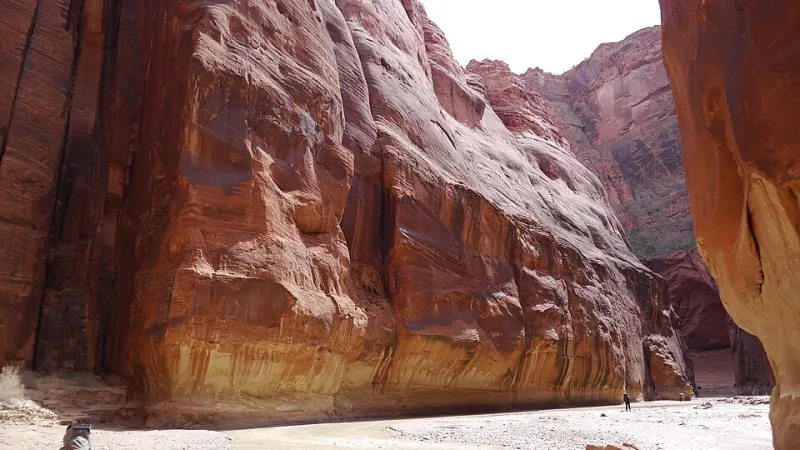
Photo: BLMArizona, Public domain, via Wikimedia Commons
Let's be honest — the wallpaper conversation gets a little predictable. Yosemite Valley. The Grand Canyon. A long-exposure of the Chicago skyline. These are stunning places, no question, but they've been so thoroughly photographed and so widely circulated that they've lost a little of their shock value. At this point, Half Dome on a MacBook is practically a cliché.
Here's the thing though: the United States is absurdly rich in visual drama. There are geological formations, hidden waterways, remote coastlines, and surreal color palettes scattered across this country that most people have never heard of — let alone used as a wallpaper. That's a shame, because some of these overlooked spots are genuinely more striking than the famous ones, and they come with the bonus of making your screen look like something nobody else has.
Consider this your guide to going off-grid, visually speaking.
The Slot Canyons Beyond Antelope
Antelope Canyon in Arizona has become so Instagram-famous that it now requires timed ticketed tours and draws thousands of visitors daily. The photography is gorgeous, but it's everywhere. What most people don't realize is that the American Southwest is riddled with slot canyons — narrow, sinuous passages carved by flash floods through sandstone — and many of them are virtually unknown outside of hardcore hiking circles.
Spooky Gulch and Peek-a-Boo Canyon in Utah's Grand Staircase-Escalante National Monument are two of the most visually spectacular. The light that filters down through those tight sandstone walls creates a warm, amber glow that shifts with the time of day — early morning turns everything copper and gold, while midday produces that signature shaft-of-light effect. These canyons are narrower and more contorted than Antelope, which means the compositions are wilder and less symmetrical. For wallpaper purposes, that unpredictability is a genuine asset.
Farther north, Buckskin Gulch — the longest slot canyon in the American Southwest — offers a more austere, almost gothic visual palette. The walls rise up to 500 feet in places, and the color shifts from pale cream to deep burgundy depending on the light. It's the kind of image that looks almost unreal on a high-resolution display.
The Painted Hills of Oregon
Most people think of the Oregon coast when they picture that state's natural beauty. And sure, Cannon Beach and the Haystack Rock are legitimately iconic. But drive inland toward the John Day Fossil Beds National Monument in central Oregon and you'll find something that stops people in their tracks every single time: the Painted Hills.
These low, rounded formations are layered in bands of red, gold, black, and green — the result of millions of years of volcanic ash deposits and ancient soils. The colors aren't subtle. They look almost digitally enhanced, like someone cranked up the saturation slider in post-production. Except they're completely real, and they photograph beautifully under overcast skies, which softens the contrast and lets the colors breathe.
As wallpaper material, the Painted Hills are nearly unbeatable. The organic shapes, the horizontal layering, and the warm color palette work perfectly on both wide desktop displays and vertical phone screens. And because they're relatively unknown outside the Pacific Northwest, your desktop will immediately stand out from the crowd.
The Wave — And Its Less-Famous Neighbors
Okay, The Wave in Coyote Buttes, Arizona, has developed a cult following among photographers. But access is strictly limited by lottery, and images of it circulate widely enough that it's starting to lose its underdog status. What's less known is the broader region around it — the White Pocket formation, accessible by high-clearance vehicle in the Vermilion Cliffs National Monument, offers equally surreal swirling sandstone patterns in a palette of cream, rust, and charcoal.
White Pocket's rock formations look like frozen ocean waves, like marble cake, like alien terrain. The visual complexity makes for extraordinarily rich wallpaper images — there's always something new to notice, which is exactly what you want from a background you'll stare at every day.
The Waterfalls Nobody Talks About
Niagara gets all the press. Multnomah Falls in Oregon has its own gift shop and a dedicated parking lot. But for every famous waterfall in America, there are dozens of hidden cascades tucked into hollows and gorges that almost nobody visits.
Falls Creek Falls in Tennessee — located in the Cherokee National Forest — drops nearly 250 feet in a narrow ribbon of white water surrounded by hardwood forest. In late spring, the surrounding rhododendrons bloom pink and purple, creating a color combination that looks almost too beautiful to be real. In autumn, the same scene transforms into a riot of orange and gold.
Out West, Proxy Falls in Oregon's McKenzie River Valley is a two-tiered cascade that fans out over a mossy basalt face — the kind of image that makes people stop and ask where it was taken. The surrounding old-growth forest gives it a primordial quality that's hard to find in more accessible spots.
For wallpaper purposes, waterfall images work especially well on mobile screens, where the vertical orientation and the natural top-to-bottom flow of the image feel completely at home.
The Great Lakes' Forgotten Shorelines
America's inland seas don't get nearly enough visual attention. The Great Lakes collectively hold about 20% of the world's surface fresh water, and their shorelines range from dramatic sand dunes to rocky northern coasts that look more like Maine than the Midwest.
Sleeping Bear Dunes National Lakeshore in Michigan offers some of the most visually striking scenery in the entire country — massive dunes that rise up to 450 feet above Lake Michigan, with views that stretch to the horizon over water so blue it looks tropical. Pictured Rocks National Lakeshore, also in Michigan's Upper Peninsula, features 200-foot sandstone cliffs streaked with mineral stains in shades of pink, green, and white. The colors are genuinely unlike anything else in American landscape photography.
These locations are unknown enough that finding a great wallpaper image from them feels like a discovery rather than a download.
Why the Underrated Always Wins
There's something that happens when you put an unfamiliar landscape on your screen — people notice. They ask where it is. They lean in. A wallpaper of the Grand Canyon gets a nod of recognition. A wallpaper of White Pocket or the Painted Hills gets a conversation.
Beyond the social dimension, there's something genuinely refreshing about choosing imagery that hasn't been algorithmically optimized into ubiquity. These hidden corners of American terrain carry the same geological drama, the same play of light, and the same emotional resonance as their famous counterparts — they've just been waiting for someone to look.
America is enormous, and the best of it is nowhere near fully explored. Your screen is a good place to start.