True Black, True America: Why Dark-Sky Parks Were Made for Your OLED
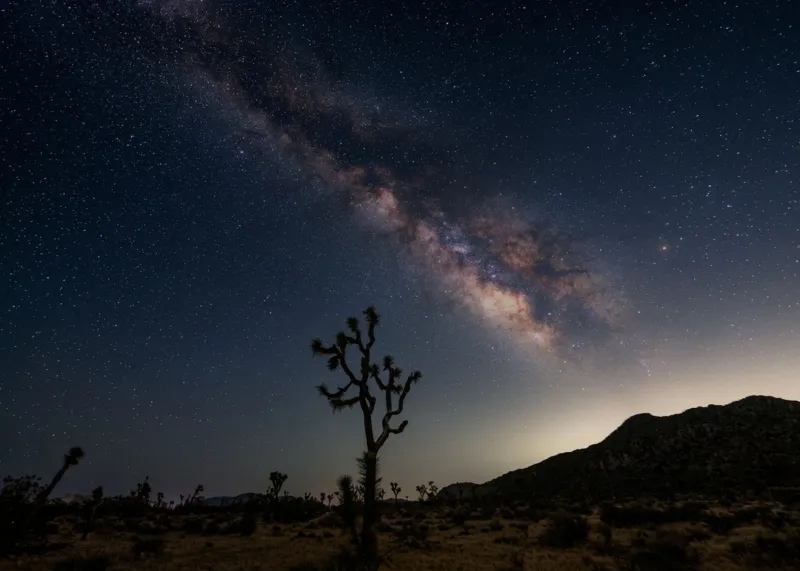
There's a quiet technical magic happening every time you set a wallpaper with a truly black background on a modern phone or monitor. OLED panels light up each pixel individually — so when a pixel is asked to display pure black, it simply switches off. It doesn't dim. It disappears. That means a photograph of the night sky over a remote stretch of Texas isn't just beautiful. It's the one category of image your screen was practically engineered to show.
And America, it turns out, has some of the best raw material on Earth for it.
The Trend Nobody Saw Coming
For years, wallpapers got louder. Neon sunsets, HDR-saturated coastlines, gradient everything. But walk into any phone store right now and glance at the display models — increasingly, people are going the other direction. Deep, moody, star-filled images with vast black negative space are quietly taking over lock screens.
Part of it is aesthetics. Dark wallpapers look sophisticated. They make app icons pop. They don't glare at you in a dark bedroom at 6 a.m. But a lot of it is physics: on an OLED display, a mostly-black image draws noticeably less power, which translates to real battery savings over a day of checking the time. Eye strain drops too, especially for night owls scrolling in bed.
So the question becomes: what do you put in all that gorgeous darkness? We'd argue the answer is overhead.
America's Certified Dark Side
The International Dark-Sky Association certifies places with exceptionally low light pollution, and the U.S. is loaded with them. These aren't just great camping spots — they're the locations where astrophotographers capture the Milky Way in full, unfiltered glory.
Big Bend National Park, Texas. Often cited as having the darkest measured skies in the Lower 48. The Milky Way here doesn't just show up — it dominates, arching over desert canyons like a painted ceiling.
Acadia National Park, Maine. Where the Atlantic meets the stars. Acadia's annual Stars Over Acadia festival celebrates skies so clear that Jupiter casts a shadow. A shot of the Milky Way rising over Cadillac Hill is East Coast night-sky wallpaper royalty.
Great Basin National Park, Nevada. Remote, high-altitude, and far from any city glow. The ancient bristlecone pines silhouetted against the galactic core make for wallpapers that look almost alien — except they're pure Nevada.
Cherry Springs State Park, Pennsylvania. Proof you don't need to fly to the desert. This small park in the Alleghenies draws astronomers from across the Northeast for its inky, detail-rich skies.
Headlands Beach and the Lake Huron coast, Michigan. The state's dark-sky preserves along the Great Lakes offer something rare: stars reflected on water, doubling the drama in a single frame.
Why Night-Sky Photos and OLED Are a Perfect Match
Think about the composition of a great astrophoto: a landscape anchor at the bottom — a ridge, a cactus, a lighthouse — and then thousands of stars dissolving into near-total blackness above. On a traditional LCD, that black sky renders as a slightly gray, washed-out haze. On an OLED, it renders as nothing. The stars appear to float directly on the glass.
That's not a subtle difference. It's the difference between looking at a picture of the night sky and feeling like the night sky lives behind your screen.
Picking the Right Shot for Your Device
A few practical pointers from our team:
- Go vertical for phones. The Milky Way's arch works beautifully in portrait orientation — the galactic core near the bottom, stars trailing up past your clock.
- Mind the horizon line. A wallpaper with a strong dark upper half keeps your notification icons readable.
- Don't over-edit. The best dark-sky images keep some natural noise and restraint. Over-processed, neon-purple Milky Ways defeat the whole point.
- Rotate seasonally. Summer brings the galactic core into view over the U.S.; winter skies trade the Milky Way for Orion and crystal-clear cold-air clarity.
The Bigger Picture
There's something fitting about all this. Light pollution has erased the night sky for roughly 80% of Americans — most of us can't see the Milky Way from home anymore. But through the lenses of photographers working in Big Bend, Great Basin, and Acadia, we can carry it with us.
Your screen goes dark to save battery. America's darkest parks go dark to save something bigger. Put the two together, and every glance at your phone becomes a small reminder of what's still up there, waiting.
True black, true America. Your OLED has been waiting for this.